Efficient and practical Hamiltonian simulation from time-dependent product formulas
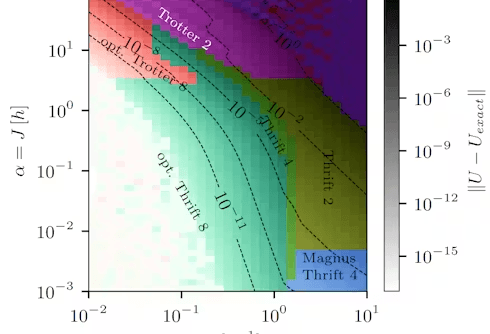
Landscape of the best TDS algorithm, as measured by the worst-case error.
QUANTUM COMPUTER
Apr 23, 2024
Bosse, J. L., et al.
In this work we propose an approach for implementing time-evolution of a quantum system using product formulas. The quantum algorithms we develop have provably better scaling (in terms of gate complexity and circuit depth) than a naive application of well-known Trotter formulas, for systems where the evolution is determined by a Hamiltonian with different energy scales (i.e., one part is “large” and another part is “small”). Our algorithms generate a decomposition of the evolution operator into a product of simple unitaries that are directly implementable on a quantum computer. Although the theoretical scaling is suboptimal compared with state-of-the-art algorithms (e.g., quantum signal processing), the performance of the algorithms we propose is highly competitive in practice. We illustrate this via extensive numerical simulations for several models. For instance, in the strong-field regime of the 1D transverse-field Ising model, our algorithms achieve an improvement of one order of magnitude in both the system size and evolution time that can be simulated with a fixed budget of 1000 arbitrary 2-qubit gates, compared with standard Trotter formulas.